

Transform Your Practice with Blockage-Based Care
Join a Network of Next-Generation Healers
Enhance your clinical expertise, improve patient outcomes, and integrate BodyMap reports, fascia protocols, and regenerative treatments into your care.
Introducing The BodyMap Report
Give your patients a new tool for more personalized care.
-
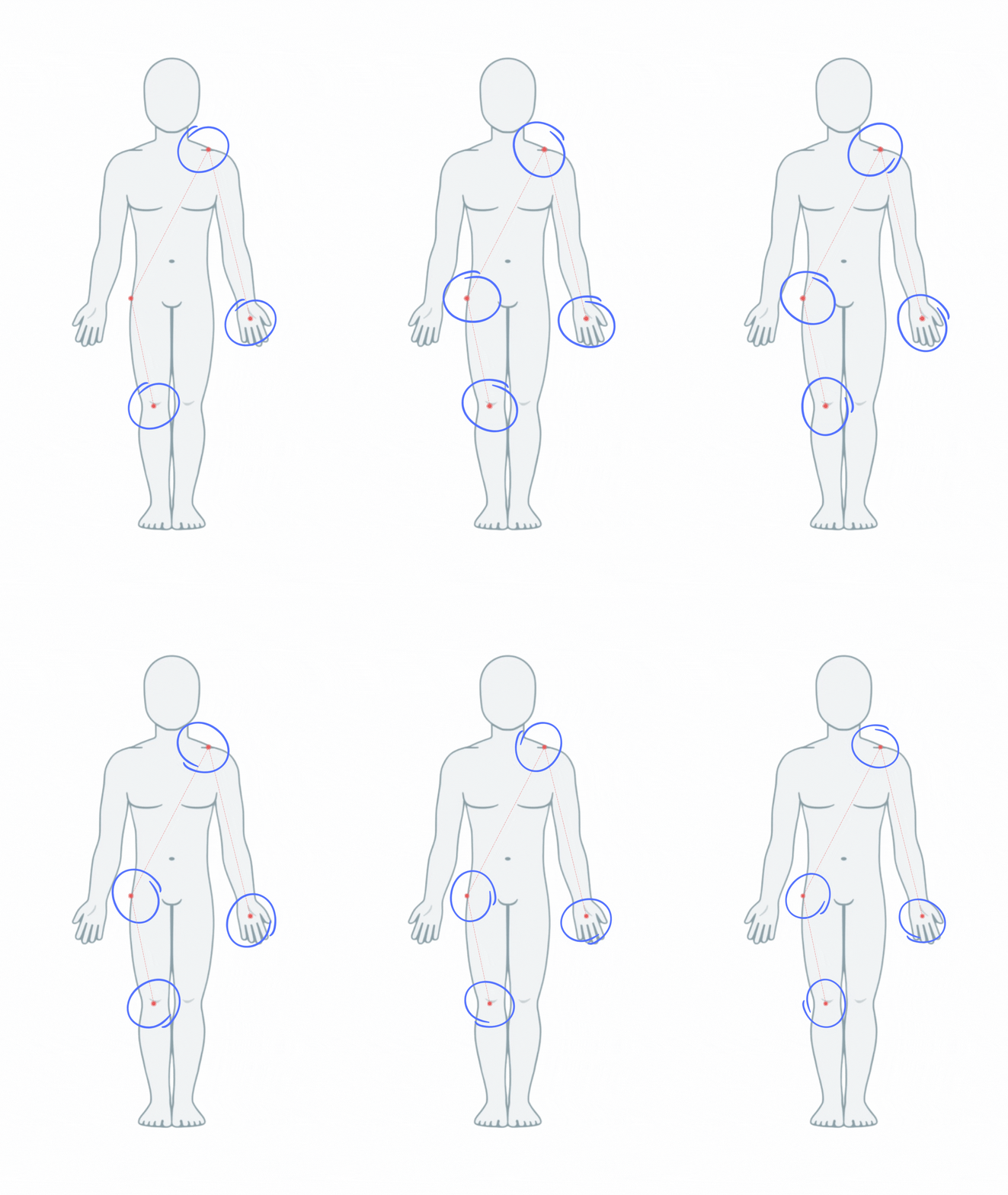
The BodyMap Report is a structured, trauma-informed clinical overview that documents a patient’s lifetime history of physical and emotional injury and translates it into a personalized map of potential fascial and neurological blockages.
Rather than focusing solely on symptomatic regions, the BodyMap identifies areas where prior injuries may have altered collagen, fascia, and nerve signaling, creating long-standing restrictions that influence movement, coordination, circulation, and healing throughout the body.
This report provides clinicians with a functional map of the patient’s body, grounded in the understanding that fascia forms continuous planes that integrate muscles, joints, and the nervous system.
-
Every injury, whether a sprain, fracture, surgical scar, infection, or dental procedure—causes tissue damage. While wounds may appear healed, changes in fascia, collagen organization, and nerve sensitivity often persist.
These residual changes, referred to as blockages, can:
Restrict movement along long myofascial chains
Alter proprioception and coordination
Contribute to compensatory patterns and secondary pain
Limit the effectiveness of otherwise appropriate treatment
Because fascia is continuous, a blockage in one region—such as an old ankle injury—may manifest years later as pain or dysfunction elsewhere, including the low back, hip, or neck.
The BodyMap makes these hidden relationships visible.
-
The BodyMap does not replace diagnosis or treatment. Instead, it enhances clinical reasoning by providing context.
For providers, it can:
Highlight regions that may warrant assessment despite being asymptomatic
Explain why treatment response has plateaued
Inform exercise selection, manual therapy focus, or movement retraining
Improve efficiency by targeting root contributors rather than local symptoms
By integrating a patient’s injury history with an understanding of fascial continuity, clinicians gain a broader framework for interpreting complex or chronic presentations.
Clinicians can use the BodyMap as a reference tool to:
Guide hands-on treatment or movement-based interventions
Coordinate care with other providers using a shared anatomical framework
Educate patients on the root causes of their symptoms
Track changes over time as blockages are addressed
Because every patient’s blockage pattern is unique, the BodyMap supports truly personalized, integrative care.
Learning Tools for Clinicians
Many chronic pain and post-surgical conditions persist not because treatment failed, but because the true lesion was never identified.
Our educational programs are built around blockage-based care, a clinical framework that integrates fascia, nerves, and meridian anatomy into a practical system for diagnosis and treatment. This work is grounded in hands-on assessment, reproducible palpation findings, and techniques that integrate seamlessly into medical, injection-based, and manual practices.
We teach meridians as real, palpable myofascial chains, not abstract energy concepts. These long planes of tissue organize movement, distribute force, and harbor hidden lesions—interference fields—that often drive pain, dysfunction, and poor surgical recovery.
-
![A man wearing glasses and a gray sweater demonstrating a medical procedure on a patient lying on a hospital bed, with other people observing.]()
Workshops
Hands-on, small-group training focused on palpation, assessment, and treatment of myofascial and neural blockages. Clinicians learn a new anatomy, a novel light-touch palpation method, and a simple two-point technique that can be applied immediately in practice.
-
![People sitting in an audience with notebooks and pens, attending a lecture or seminar.]()
Courses
Structured, multi-session programs that deepen understanding of blockage-based care across clinical contexts, including chronic pain, post-surgical syndromes, and complex regional dysfunction. Designed for integration into real-world medical practice.
-
![A digital illustration of a human body showing internal skeleton and organs, with red highlights on the head, shoulder, and knee indicating pain points, and white arrows pointing to the head, shoulder, and knee.]()
Webinars
Focused, clinically relevant sessions addressing specific problems such as post-surgical pain, failed interventions, and difficult-to-diagnose conditions. Ideal for learning the framework, refining assessment strategies, and applying concepts efficiently in busy practices.




Offer your patients a unique, fascia-focused therapy that complements your care.
Our method targets blockages—hidden restrictions in fascia that can persist after injury and contribute to chronic pain and dysfunction. Through guided movement, breath, and awareness, patients actively release these restrictions for lasting results.
All referrals include a personalized treatment plan to develop a personalized treatment plan, ensuring continuity of care and enhanced outcomes. We value collaboration and will keep you updated on your patient’s progress.